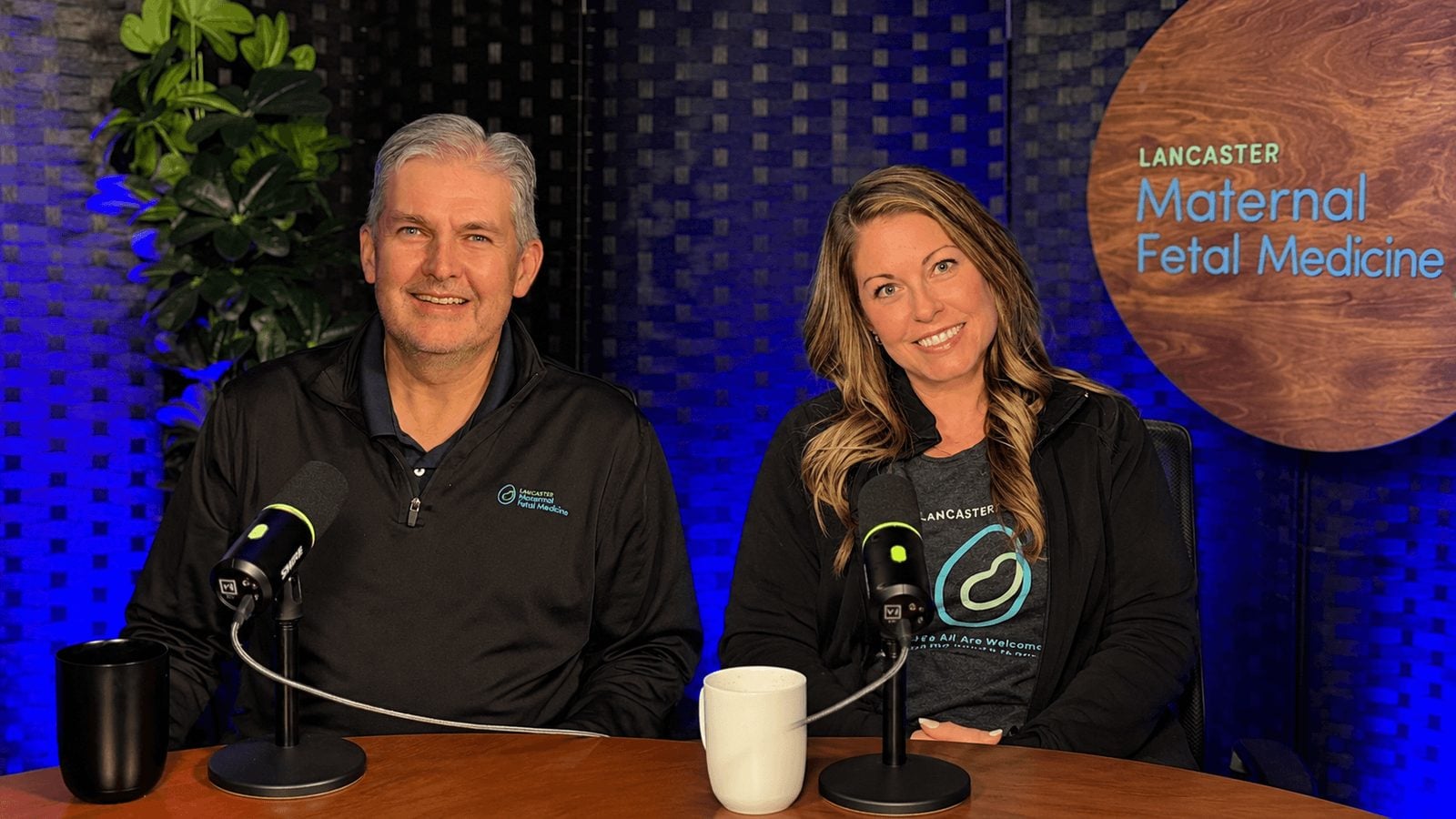
Meet Dr. Jaimie Maines, the Newest Member of the LMFM Physician Team
In this episode, Dr. Larkin welcomes Jaimie Maines, MD, a board-certified maternal-fetal medicine specialist who recently joined Lancaster Maternal Fetal Medicine. Dr. Maines brings experience in general obstetrics, academic medicine, and complex pregnancy care.
She completed her OB/GYN residency in 2012, served as an Air Force OB/GYN in Alaska for three years, and later returned to Pennsylvania to work in academic medicine. Her clinical interests include fetal anomalies, fetal growth concerns, maternal medical conditions, multiple gestations, and prenatal genetic testing. During the conversation, she describes how welcomed she has felt since joining LMFM and how much she values having time to listen to patients.
Dr. Maines and Dr. Larkin agree on an important point: expert medical care matters, but so does the way people feel while receiving it. A patient may be facing a complicated diagnosis, an uncertain ultrasound result, or the understandable worry of an early pregnancy. The team wants that person to leave with clearer information and a plan.
What to Expect at Your First MFM Appointment, Step by Step
One of the best parts of Episode 2 is the office tour. Instead of asking you to imagine what a maternal-fetal medicine office looks like, Dr. Maines shows where patients go and introduces several of the people they might meet.
1. Arrive at the Office and Check In
The episode’s tour takes place at LMFM’s Lancaster office at 2568 Lititz Pike, Lancaster, PA 17601. The entrance has stairs and a ramp. Inside, you will find a waiting area with seating, water, and a nearby restroom.
At the front desk, Brenda helps patients check in and complete any necessary paperwork. Some forms may be completed in advance, while others can be handled in the office. If you have questions about forms, your appointment, or what happens next, you can ask.
2. Have Your Vital Signs Taken
After check-in, a staff member brings you back for vital signs. The tour shows a dedicated room used for this part of the visit and for blood draws when needed. Your exact evaluation depends on the reason for your appointment and the tests your care team has ordered.
For a first MFM appointment, it can be helpful to have a medication list and relevant information about your health and pregnancy available. The American College of Obstetricians and Gynecologists (ACOG) prenatal care guide recommends reviewing medical history, medications, previous pregnancies, and other important details with your pregnancy care professional.
3. Visit an Ultrasound Room
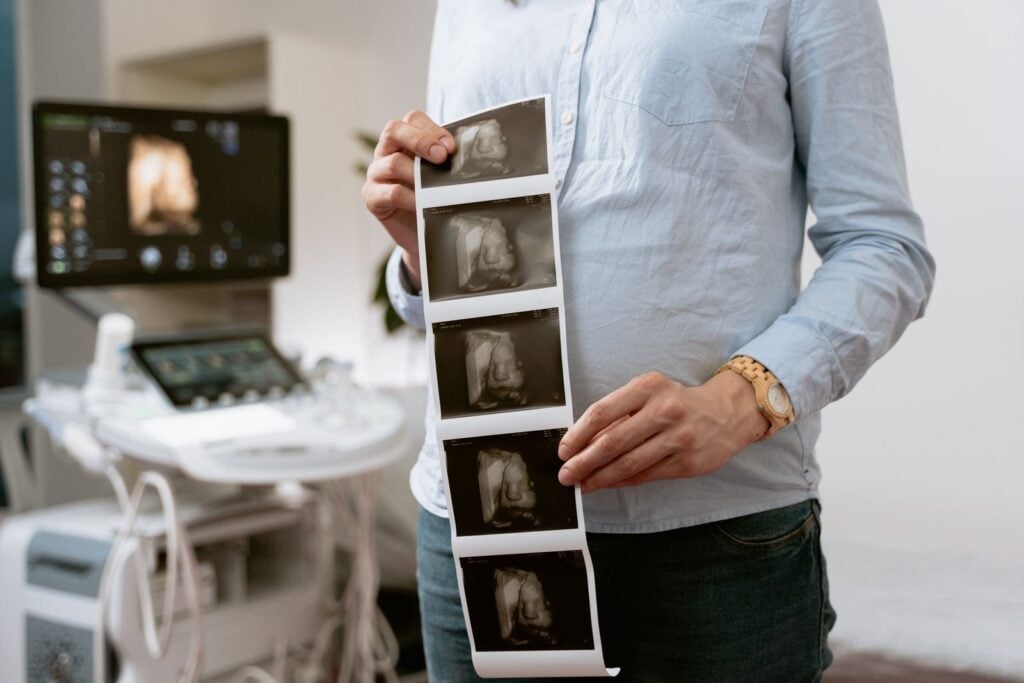
Next comes one of the most familiar parts of pregnancy care: the ultrasound. Dr. Maines shows one of the Lancaster office’s five ultrasound rooms. Each has an examination bed, an ultrasound machine, and a chair for a support person. Patients can also watch the ultrasound images on a screen during the examination.
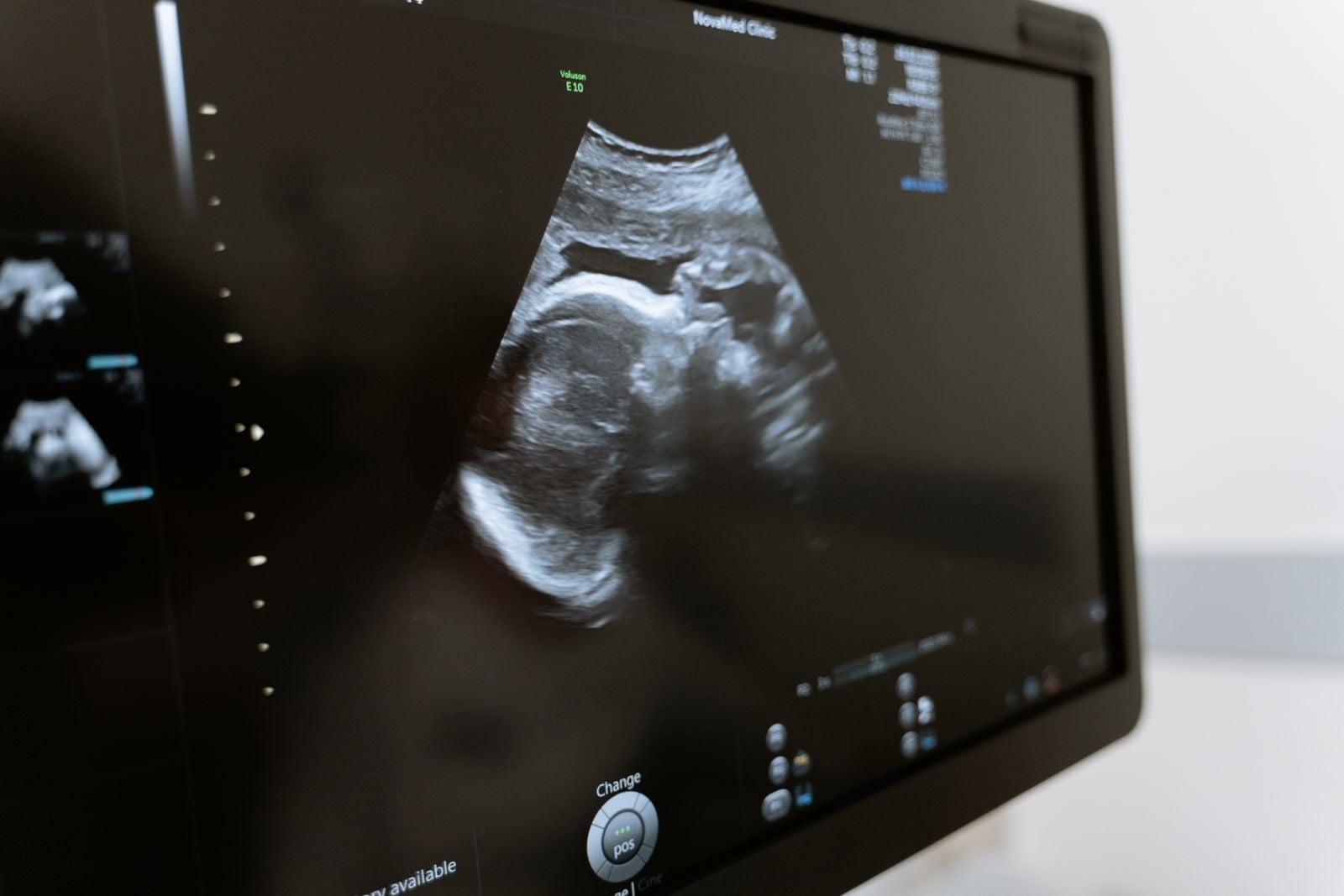
The specific type of scan depends on your pregnancy, your gestational age, and the reason you are being seen. For example, LMFM provides routine prenatal ultrasounds as well as specialized imaging and other diagnostic services. An ultrasound may help your team evaluate pregnancy dating, fetal growth, anatomy, or a particular concern. No single scan can answer every question about a pregnancy.
If you want to understand the different types of pregnancy ultrasound, ACOG has a helpful guide to ultrasound exams.
4. Discuss Your Results and Questions With a Provider
At LMFM, the scan is only part of the appointment. Dr. Maines explains that the sonography team reviews the images and communicates its findings to the physicians. After the ultrasound, a provider comes in to review the examination, discuss what the results mean, and answer questions.
This conversation is central to the practice’s approach. Dr. Larkin describes a shared provider schedule that gives the team flexibility. If one patient needs an especially detailed conversation about a complex finding, colleagues can help care for other patients. That allows the discussion to receive the attention it needs rather than being cut short simply because a time slot has ended.
You can ask questions about the ultrasound, your pregnancy, what comes next, or information you did not fully understand. Dr. Maines encourages patients to speak up, even when the question feels small.
5. Schedule Any Follow-Up Care and Check Out
After your visit, a staff member helps with checkout and any follow-up appointments that are needed. Some patients may need one evaluation, while others will be seen again for additional ultrasound imaging, counseling, or ongoing monitoring. The frequency of visits depends on your individual situation.
Importantly, the conversation does not have to end when you leave the building. Dr. Larkin says patients can call or email the practice when questions come up after an appointment. The team also communicates with referring OB/GYNs and other pregnancy care professionals to help everyone work from the same information.
Meet the People Behind Your Pregnancy Care
A first visit can feel less intimidating when you recognize a few faces. During the Episode 2 tour, viewers meet several members of the Lancaster MFM team:
- Brenda at the front desk: Helps patients get checked in and complete paperwork.
- Amanda and Stephanie, nurse practitioners: Assist with patient intake, consultations, and questions.
- Jaime, a physician assistant: Works alongside the providers during consultations and ultrasound reviews.
- Maddie, Tiffany, and Lindsey, sonographers: Are among the team members involved in performing ultrasound examinations and discussing findings with the physicians.
- Nicole, a nurse: Helps with intakes and consultations.
- Dr. James O’Brien: Another new maternal-fetal medicine physician introduced during the tour.
The episode also shows a comfortable consultation room where patients can sit and talk about their pregnancy. Behind every ultrasound and care plan is a broader group of clinical and administrative professionals who help make each visit possible. You can learn more about the physicians and advanced practice providers on LMFM’s team page.
Why LMFM Emphasizes Early Access to Pregnancy Care
A major theme of the conversation is timely access. Dr. Larkin explains that patients in Central Pennsylvania can face long waits for an initial prenatal appointment or an early ultrasound. Dr. Maines shares that she has already spoken with patients who were concerned in early pregnancy and had difficulty getting an appointment elsewhere.
LMFM’s goal is to make timely evaluations available when they are medically appropriate. That does not mean every patient needs extra visits or ultrasounds. Instead, the team aims to see patients when a visit is useful and to explain why a particular follow-up is recommended.
An early ultrasound can provide clinical information and may help someone feel more informed. However, as Dr. Maines points out in the episode, an ultrasound cannot by itself prevent a pregnancy loss or guarantee an outcome. If you are having bleeding, pain, or other concerning symptoms, contact your pregnancy care professional promptly for advice rather than relying on reassurance from a previously scheduled scan.
Patients do not have to assume that maternal-fetal medicine is only for the highest-risk situations. Lancaster MFM also provides routine ultrasound services and welcomes self-referrals. You can review the practice’s frequently asked questions or request an appointment to discuss your needs.
Why Feeling Heard Matters, Especially During a High-Risk Pregnancy
Pregnancy often brings a mix of excitement, uncertainty, and questions. Those emotions can feel even stronger when someone is waiting for testing or has received unexpected news.
Dr. Maines says one of the most meaningful moments in an appointment is seeing a worried patient become more comfortable after being heard and developing a plan. That plan may involve additional testing or follow-up rather than immediate answers. Still, knowing the next step can make a difficult situation easier to navigate.
Dr. Larkin encourages patients to focus on one visit at a time instead of trying to predict the entire pregnancy at once. The broader message is not that every concern has a simple solution. It is that patients deserve clear explanations, thoughtful attention, and an opportunity to participate in decisions about their care.
LMFM also works collaboratively across healthcare systems. If you already see an OB/GYN or midwife, the MFM team can share findings and recommendations with that provider. Specialized consultations are designed to add expertise and coordination, not automatically replace the pregnancy care team you know.
What Is a Nonstress Test? A Look Inside the Monitoring Room
The tour includes LMFM’s nonstress testing room. This is a space used for certain patients who need additional fetal monitoring later in pregnancy. The room has reclining chairs and seating for support people.
A nonstress test (NST) measures fetal heart rate patterns over time and looks at how the heartbeat responds to fetal movement. In the episode, Dr. Maines describes a monitoring session lasting about 20 minutes. Some patients may need a longer test depending on the clinical situation and the results.
Not everyone needs an NST. It may be recommended for particular pregnancy conditions or concerns. ACOG explains the purpose of the test and other monitoring options in its guide to special tests for monitoring fetal well-being.
How to Prepare for Your First MFM Appointment
If your first MFM appointment is coming up, a little preparation can help you make the most of your time with the team.
- Confirm your location: The office featured in this episode is in Lancaster. LMFM also serves patients in the Reading area, where the office layout may differ.
- Ask about paperwork: Find out whether forms need to be completed before you arrive.
- Bring relevant information: Have an up-to-date list of medications, your medical history, prior pregnancy details, and any records your team has requested.
- Write down questions: It is easy to forget something important when you are nervous or focused on an ultrasound.
- Ask about a support person: LMFM welcomes family involvement when appropriate, although room guidelines can vary by examination.
- Leave time for discussion: Some visits involve more counseling or testing than others. If timing matters, ask the office what to expect for your specific appointment.
Questions worth bringing include: What was the ultrasound looking for? What did you find? Are additional tests recommended? When should I follow up? How will information be shared with my usual pregnancy care provider?
Pregnancy Care in Lancaster and the Reading Area
Lancaster Maternal Fetal Medicine provides advanced prenatal imaging, specialized consultation, and coordinated pregnancy care to patients in Lancaster County, Berks County, and surrounding Central Pennsylvania communities. The practice has an office at 2568 Lititz Pike, Lancaster, PA 17601 and a Reading-area location at 2208 Quarry Drive, Suite 207, West Lawn, PA 19609.
To learn about the range of testing and consultations available, explore LMFM’s pregnancy services. For a broader explanation of the specialty, read What Does a Maternal Fetal Medicine Doctor Do?, based on the first episode of The Pregnancy Consult.
Ready to schedule or ask a question? Request an appointment online, visit the contact page, or call (717) 288-8118.
This article is educational and describes the Lancaster office shown in The Pregnancy Consult, Episode 2. The order and components of an actual appointment may vary based on your medical needs. The information here does not replace personalized medical advice.
Frequently Asked Questions About Your First MFM Appointment
What happens at my first MFM appointment?
At Lancaster MFM, a typical first MFM appointment includes check-in and paperwork, vital signs, an ultrasound if scheduled, and a discussion with a provider. Your visit may include other services based on your individual medical needs. You will have an opportunity to ask questions before leaving.
Do I need a referral to see Lancaster Maternal Fetal Medicine?
No. Lancaster Maternal Fetal Medicine welcomes self-referrals as well as referrals from OB/GYNs, midwives, and other healthcare professionals. Contact the office about scheduling and insurance requirements that may apply to your plan.
Will I receive an ultrasound at my first appointment?
Many LMFM pregnancy appointments include ultrasound imaging, but the exact testing depends on why you are being seen. The office can explain what is scheduled for your specific first MFM appointment.
Will someone explain my ultrasound results?
Yes. In the episode, the physicians explain that patients meet with a provider after their ultrasound to discuss findings, ask questions, and understand the next steps. Your visit and any recommended follow-up are tailored to your circumstances.
How long does an appointment at Lancaster MFM take?
LMFM’s published FAQs say most appointments last approximately 30 minutes to one hour, though more complex imaging, counseling, or other testing may take longer. Ask the office for guidance about the time needed for your scheduled service.
Can my partner or another support person come with me?
LMFM welcomes family members and support people when appropriate. Its Lancaster ultrasound rooms include a chair for a support person. Rules may vary based on the type of examination, so ask ahead if you plan to bring someone.
What is a nonstress test during pregnancy?
A nonstress test, or NST, is a way to monitor fetal heart rate patterns in relation to fetal movement. It may be recommended for certain pregnancies needing additional surveillance. Not every patient will need this test.
Will Lancaster MFM communicate with my OB/GYN or midwife?
Yes. Dr. Larkin and Dr. Maines explain that LMFM works with outside pregnancy care providers and shares information to support coordinated care. You can ask how and when recommendations from your visit will be communicated.
Where is Lancaster Maternal Fetal Medicine located?
The Lancaster office featured in the episode is at 2568 Lititz Pike, Lancaster, PA 17601. The practice also has a Reading-area office at 2208 Quarry Drive, Suite 207, West Lawn, PA 19609. Visit the contact page to confirm where your appointment is scheduled.